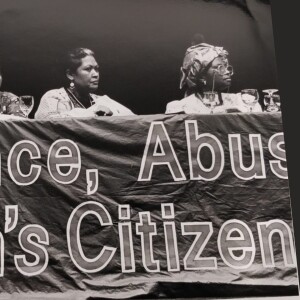
FiLiA Presents the Violence, Abuse and Women’s Citizenship Conference of ‘96
The resilience and courage of the International Women’s Rights Movement in the 90s is retold in this unique exhibition retelling the Violence, Abuse and Women’s Citizenship Conference of ‘96. Legendary feminists including Andrea Dworkin, Phylls Chesler, Norma Hotaling, Jalna Hanmer, Sheila Jeffreys, Janice Raymond and Teboho Maitse attended and, for the first time, women from across the world came together to form alliances.Through this exhibition, we explore the global political and social landscape of the 90s that led to the demand for this phenomenal event.
Listen on:

Episodes
Thursday Oct 02, 2025
Thursday Oct 02, 2025
From 1996:
"
The personal and political costs to women, and children, of inadequate or inappropriate social support after leaving a violent relationship are multiple and severe. This paper is based on a study carried out on a housing estate in Sheffield (UK) between 1993 and 1994. It will look at factors influencing women’s experiences of social support and the process of social support for the women compared to their violent male partners. Seven major factors were found to affect the process of social support, all of which are impacted upon by hegemonic heterosexuality, making it difficult for women to stay out of the violent relationship. The violent men’s disruption of their partners’ social support and the relatively high level of active and passive support for the violent men meant that women were left largely isolated. New approaches are needed to deal with this serious social problem. I will describe one model of a new service provided in the experimental project set up in this study to encourage networking of female support and friendships.
Paula Wilcox is a feminist researcher at the University of Bradford. With a background in criminology and women’s studies, she has taught “Women, Feminism and the Law” at Sheffield and “Research Methods” at Bradford. She has worked on several major research projects including “Targeted Crime Reduction for Local Areas” (Home Office), “Violence, Abuse and the Stress Coping Process” (ESRC), and “Keighly Domestic Violence Project” (Home Office) as the Project Evaluator. Paula is currently working on the “Rotherham Domestic Violence Repeat Victimisation Project” and has recently submitted her PhD thesis on “Social Support and Women Leaving Violent Relationships.”
Since 1996:
Paula Wilcox is a Professor at the University of Brighton, specialising in Sociology, Law, and Gender.
Friday Oct 03, 2025
Friday Oct 03, 2025
From 1996:
"
Numerous studies have shown the nature and endemic character of intimate violence against women. The ultimate responsibility for such violence rests with the men perpetrating it. However, this does not render women incapable of agency or action. What can women do to contribute to the transition from violent to violence-free lives?
This paper will explore three routes to resolution of violence - women leaving men, men leaving women and the couple staying together with a halt in the use of violence. It will do so by considering the responses of the women being abused and the resources, both economic and social, which they can mobilise in their own interests. The paper will draw on data collected in Calcutta (India) from women having a range of social, economic and religious backgrounds. Some of the women were pre-selected through support organisations while others were not pre-selected but unknown. High rates of both physical and sexual violence were found to exist and many women also reported that violence had stopped. The varied experiences of women in each of the three routes will be presented; personal and social characteristics will be discussed. An important lesson emerging from this study is the significance of social citizenship in enabling women to resist male violence effectively.
Purna Sen has worked in further, higher and adult education in the UK, particularly on issues of race and gender. She has been involved in training and consultancy work in these areas. She has also worked with refugees in London, where she worked with community groups on needs assessment projects. Returning to college as a mature student she carried out the PhD research on which this paper is based in India during 1994-95. "
Since 1996:
Purna Sen is a Visiting Professor at the Child and Woman Abuse Studies Unit at London Metropolitan University, former Chair of the anti-domestic violence charity Respect, and former policy director at UN Women.
Friday Oct 03, 2025
Friday Oct 03, 2025
In this speech, Rada Gungaloo discusses the work of her organisation SOS Femmes, and the dynamics between mother in laws and daughter in laws in Mauritius with regard to domestic violence.
Rada Gungaloo was a lawyer, who founded SOS Femmes in 1989. SOS Femmes is still providing support to Mauritian women affected by domestic violence. Rada Gungaloo died in 2015.
Friday Oct 03, 2025
Friday Oct 03, 2025
In ths speech, Kristina Morvai draws parallels between attitudes to violence in war, and violence in domestic relationships, and shares her research into domestic violence in Hungary.
Krisztina Morvai is a lawyer who has previously worked for the European Commission of Human Rights and served as a Member of the European Parliament for Hungary.
Friday Oct 03, 2025
Friday Oct 03, 2025
From 1996:
The economic, social and political costs have been far greater than anticipated when the economic and social reforms were introduced in the former Soviet Union in 1989. Children and young people have been hit the hardest. Only a skeleton of the former massive state welfare system remains. All organizations for children and young people have collapsed and have not been replaced with new activities. Weakened social networks and disintegration of the old value system have left the children in a vacuum. The number of children who are abandoned, abused, neglected and involved in criminality is increasing and no help is available,
Lack of food and essential drugs threaten the life and health of children. Lack of schools, school books and teachers deprive the children of an education. Many of the children living on the streets have run away from families or institutions, where they have been abused or sexually exploited. Due to the lack of any other means of survival, girls are forced into prostitution and boys into organized crime. The only solution to social problems involving children is institutions. Most children look on the institutions as a prison. Children with disabilities frequently receive an incorrect diagnosis, get no treatment and are severely neglected.
Anitha Ronstrom is a child psychologist, social worker and journalist. She was the Children’s Ombudsman in Sweden for thirteen years. Since 1986 she has been working with women and children living in war zones and refugee camps and with children who have been abused, neglected or sexually exploited or are handicapped. She provides training and supervision for professionals in Sweden and developing countries. She is also a writer and lecturer.
Since 1996:
No more recent information on Anitha Ronstrom was found.
Friday Oct 03, 2025
Friday Oct 03, 2025
In this speech, Julie McNamara criticises psychiatric treatment and shares her experience of violence in this context.
Julie McNamara is the co-founder of Vital Xposure, a disability-led theatre company, and former Artistic Director of London Disability Arts Forum.
Saturday Oct 04, 2025
Saturday Oct 04, 2025
From 1996:
Braganca Paulista, a small city in the interior of the state of Sao Paulo, is known for its traditional values, peaceful lifestyle, and small town atmosphere. This city is representative of small cities in the interior of Southern Brazil, which are considered among the least violent as well as most affluent in the country. Rio de Janeiro, on the other hand, is currently one of the most densely populated cities of the world and is known for its high level of violence. Statistics are lacking which show how the general population, and children in particular, are being affected by this violence.
Brazil has nearly the worst distribution of income in the world. The purpose of this study is to investigate the level of violence being experienced by adolescents in these two Brazilian cities, with an emphasis upon the difference in violence experienced by adolescents of different social classes. The study is also concerned with the developmental consequences to these children and how this violence, and its effect on children, is shaping Brazilian society. This paper will address the level of violence adolescents have witnessed or experienced outside the home.
Maria Aparecida Barbosa Marques is the current Dean of the Institute for Graduate Research, University of Sao Francisco, Brazil. She is a researcher in the area of domestic violence.
Since 1996:
No current information on Maria Aparecida Barbosa Marques was found.
Saturday Oct 04, 2025
Saturday Oct 04, 2025
From 1996:
The majority of women who engage in prostitution in Chile come from the most impoverished sectors in society. The age of entry into prostitution has gone down, with increasing numbers of adolescent girls engaging in sexual commerce in the street, as well as using prostitution as a means of obtaining drugs. The majority of adult women who engage in sexual commerce see their entry into prostitution as a strategy for economic survival, especially during the economic crisis of the 1980s. These women have adopted the use of the condom in their sexual practices as a way of preventing AIDS and STDs.
They have even elaborated strategies for putting the condom on their clients without them noticing.
Since 1990 the Instituto de la Mujer has implemented a strategy which encompasses intervention/action, targeted at adult women who engage in sexual commerce in the three main Chilean cities where HIV/AIDS are highest. Emphasis is placed on training some of these women as monitors in the prevention of AIDS and STDs, especially that they replicate their experience among their peers. To date ninety-four women have been trained, and we have received economic support from the European Union to train another eighty women as monitors in the next two years.
Mariela Cortés began her career as a sociologist researching issues of women’s health such as abortion, maternal-child health care, prostitution and AIDS/STD prevention work. Her work with adult female prostitutes started during the initial stages of the AIDS/STD Prevention Programme at the Instituto de la Mujer in Santiago, Chile in 1990, in conjunction with CONASIDA (National Commission for AIDS), Ministry of Health. She has participated in the elaboration of manuals and other materials which are now used throughout Chile in the training of adult female prostitutes as monitors, as well as AIDS prevention material targeted at other groups. She is now the National Coordinator of the Programme.
Since 1996:
As of 2010, Mariela Cortes was Liaison Officer for UNFPA Chile. No further information was found.
Monday Oct 06, 2025
Monday Oct 06, 2025
From 1996:
This presentation describes the nature and extent of the problem of trafficking in women in rural Bangladesh. More precisely, it aims to present the situation of those trafficked women who, after extremely bitter and horrid experiences, return to their home countries. They are referred to as returnees. Research by the Association for Community Development (ACD) reveals a number of social and economic problems faced by these women. They are often ostracized or made objects of gossip. Their neighbours are reluctant to accept them, as Bangladeshi society is still tradition ridden. Among these women, the most vulnerable group is the permanent returnees. Most of them are in all probability carriers of HIV/AIDS. Additionally, many women returning home resort to unlawful means. They therefore risk revenge from the flesh dealers or arrest by authorities. In either situation legal aid is rarely available to them, though ACD does sometimes extend such help.
This small scale study highlights the need for further investigation on the condition of trafficked women. It is hoped that these findings may evoke interest in persons who care for human rights.
Since 1996:
The Association for Community Development is ongoing and Salima Sarwar remains its Executive Director.
Monday Oct 06, 2025
Monday Oct 06, 2025
In this speech, feminist lawyer Sarah McGuire discusses the barriers to addressing rape in war at international tribunals, and her work with Lawyers International Forum for Women's Human Rights to address this.
Sarah Maguire is now global director of safeguarding for international development company DAI.