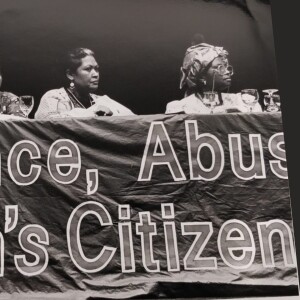
FiLiA Presents the Violence, Abuse and Women’s Citizenship Conference of ‘96
The resilience and courage of the International Women’s Rights Movement in the 90s is retold in this unique exhibition retelling the Violence, Abuse and Women’s Citizenship Conference of ‘96. Legendary feminists including Andrea Dworkin, Phylls Chesler, Norma Hotaling, Jalna Hanmer, Sheila Jeffreys, Janice Raymond and Teboho Maitse attended and, for the first time, women from across the world came together to form alliances.Through this exhibition, we explore the global political and social landscape of the 90s that led to the demand for this phenomenal event.
Listen on:

Episodes
Friday Sep 26, 2025
Friday Sep 26, 2025
From 1996:
“The issue of violence against women has been one of the most unifying problems addressed by the international women's movement, cutting as it does across time, class, geographical space, culture and economic system. Women stand united in the fight against violence be it directed against themselves or in the form of war or day-to-day aggression. It is no surprise that grassroots women’s organisations have formed action plans addressing issues such as women’s shelters, asylum seekers, sexual abuse of girls, etc. Whilst these actions are of the utmost importance the political aspect of violence against women has not received sufficient attention and violence against women is still mainly treated as a problem belonging to the private sphere.
The European Women's Lobby, created to influence ECU legislation, is prepared to take on the challenge of bringing the experiences and recommendations of women's grass roots organisations to the highest political level. It proposes to create, initially, a European observatory on violence to take stock of legislation and the extent of violence against women in the European Union. Furthermore, the EWL proposes to create a separate office within its structure for the purpose of lobbying on all issues in relation to violence against women.”
Since 1996:
Barbara is a former European Social Affairs Commissioner, European spokesperson for the environment, and Director of the European Anti-Poverty Network. She is now an independent consultant on gender policies, with expertise in EU social and environmental policies, and Vice-President of Gender Five Plus.
Friday Sep 26, 2025
Friday Sep 26, 2025
In this clip, a disabled woman criticises a session room for being inaccessible, and asks for solidarity from other women when a session is held in an inaccessible room.
Saturday Sep 27, 2025
Saturday Sep 27, 2025
In this speech, Comfort Ottah, who was filling in for Efua Dorkenoo, founder of the organisation Forward, explains Forward's work against female genital mutilation.
Saturday Sep 27, 2025
Saturday Sep 27, 2025
From 1996:
"
The Republic of Palau, a tiny Pacific Island nation of 15,122 people, is situated 3,000 miles west of Hawaii and 800 miles east of Mindanao in the Philippines. Palau’s archipelago is known for its unique coral reef environment recognised by experts as the number one underwater Wonder of the World.
Palau is an ancient matrilineal culture where women traditionally select the chief. When a western form of government was introduced women lost their traditional right to participate in political decision making. But when the United States wanted to establish a military base with nuclear weapons on the island, women’s strength was required to stop them. Three decades ago when we were told by the US to write our own constitution we were overjoyed. Finally, after 200 years of colonialism, this was our chance as people to define and charter our future. Thus, the Nuclear Free Constitution was conceived and created by our leaders for us. The Nuclear Free Constitution was a ray of hope to protect our small population and our small fragile environment, and it was our contribution to a healthy world.
Isabella is an educator and a translator of the Compact of Free Association to Palaun language. She represented the Otil A Beluad Women’s group at the US Congressional Hearing and at the United Nation Trusteeship Council meeting."
Since 1996:
Isabella Sumang contributed to the 1998 collection Pacific Women Speak Out, along with other conference speakers Zohl de Ishtar and Cita Morei, to document the Pacific Islanders' resistance to colonisation.
Saturday Sep 27, 2025
Saturday Sep 27, 2025
From 1996:
"
‘The Republic of Palau, a tiny Pacific Island nation of 15,122 people, is situated 3,000 miles west of Hawaii and 800 miles east of Mindanao in the Philippines. Palau’s archipelago is known for its unique coral reef environment recognised by experts as the number one underwater Wonder of the World.
Palau is an ancient matrilineal culture where women traditionally select the chief. When a western form of government was introduced women lost their traditional right to participate in political decision making. But when the United States wanted to establish a military base with nuclear weapons on the island, women’s strength was required to stop them. Three decades ago when we were told by the US to write our own constitution we were overjoyed. Finally, after 200 years of colonialism, this was our chance as people to define and charter our future. Thus, the Nuclear Free Constitution was conceived and created by our leaders for us. The Nuclear Free Constitution was a ray of hope to protect our small population and our small fragile environment, and it was our contribution to a healthy world.
Cita is a Social Studies teacher, and a Community Organiser for Otil, a Beluad Women’s Centre. She is also a Petitioner on behalf of a Beluad Women’s Group at the United Nations Trusteeship Council meeting in 1990."
Since 1996:
Cita Morei continues her activism for women's liberation and nuclear disarmament, and has written two books on these topics.
Sunday Sep 28, 2025
Sunday Sep 28, 2025
From 1996:
"
Since the early 1980s radical feminists have exposed the gamut of reproductive technologies as violence against women. ‘New’ reproductive technologies such as in vitro fertilisation, prenatal screening, maturing immature eggs and the development of artificial wombs have been scrutinised as much as ‘old’ reproductive technologies: the increasing battery of provider controlled contraceptives such as Depo-Provera, Norplant, chemical abortifacients (RU486), and the anti-fertility vaccine. Feminist critiques have also included the growing medicalization of women’s bodies from childhood to old age: reduced to a multitude of disembodied fragments, women’s bodies are declared to be in need of technological improvements be these drugs for menstrual irregularities such as hormone replacement therapy (HRT) or cosmetic surgery. Indeed, with the advent of ‘cyborgs’ - part human, part machine - and a growing interest in ‘post-human’ organisms on the one hand, and the promises of gene therapy to produce perfect bodies on the other, the notion of the superiority of ‘technologies’ is gaining ground. This is true even in feminist quarters not least through the post-modern insistence that disembodiedness through ‘life on the screen’ - the Internet - opens new spaces for women.
In this paper I wilt critically assess these developments for women’s daily lives in an international context. Who holds power and is in control of these technologies and in whose interest are they developed? I question whether the reduction of real live women to cut-and-paste bodies whose (reproductive) organs can be selectively manipulated, is providing women internationally with increased ‘choices’, a better quality of life and human rights. Instead I will argue that this reduction of women’s bodies/minds/spirits/souls to texts without contexts and minds without matter is increasing women’s alienation from their own Selves, I believe that this may lead to an escalation of medical and technological violence against women and will discuss Strategies for preventing this further attack on women’s liberation and global citizenship.
Renate is a founder of the Feminist International Network of Resistance to Reproductive and Genetic Engineering (FINRRAGE). Renate is a women’s health activist and has, for the past 15 years, been researching violence against women through various reproductive technologies. She has (co) authored and (co) edited five books on these technologies as well as four books on feminist theory. Renate is currently a Senior Lecturer and the Director of the Australian Women’s Research Centre at Deaken University, Australia. Her latest book is an international anthology edited with Diane Bell, Radically Speaking: Feminism Reclaimed, 1996."
Since 1996:
Renate Klein was an associate professor of Women's Studies at Deakin University until 2006. She co-founded the feminist publisher Spinifex Press in 1991 and is also an author with a focus on reproductive technology.
Sunday Sep 28, 2025
Sunday Sep 28, 2025
In this speech, Zohl de Ishtar, who collated the book Daughters of the Pacific, speaks about nuclear testing in the Pacific island of Mururoa.
Zohl de Ishtar is an Irish-Australian sociologist and nuclear disarmament campaigner, who was nominated for a Nobel Peace Prize in 2005.
Sunday Sep 28, 2025
Sunday Sep 28, 2025
From 1996:
"
According to statistics, Brazil has approximately 16 million girls between the age of 10 ami 19 years. According to UNICEF, 2 million girls between 10 and 15 are prostitutes and research in 1990 points to more than 800,000 living in the streets. Most of these girls are black and are seen by the population as delinquents. Increasing poverty, domestic violence and sexual abuse practised by the father or close relatives and lack of action by the authorities, all contribute to make girls extremely vulnerable to all kinds of violence. One of the biggest problems Brazil is facing at present is child exploitation/prostitution dee to sex tourism. This has placed Brazil as the second country after Thailand as the champion of this kind of violation of girl’s rights. To confront this fact a national campaign is being developed to raise the commitment of the population to denounce and not tolerate the sexual exploitation of girls. Special police stations and refuges have been implemented by some municipalities. In Brazil the legislation on children and youth rights is advanced in theory and rarely put into practice, placing Brazil in the forefront of indifference towards violence against women and girls, Some years ago, international human rights groups denounced the situation in Brazil; Brazil solved and continues to solve the problems with its children by killing them through hunger and bullets.
Alzira is a Black feminist activist and writer. She created the Black Women’s Cultural Centre in 1990 and is currently the Centre Director. Alzira has created a system of legal and psychological support for victims of domestic, racial and sexual violence, assisting an average of 400 women per year. In 1993, she was appointed as one of the Brazilian non- governmental delegates to the United Nations Conference on Human Rights in Vienna. Since 1995, Alzira has been the Brazilian co-ordinator of the Latin American and Caribbean Feminist Network against Domestic and Sexual Violence."
Since 1996:
Alzira Rufino was nominated for a Nobel Peace Prize in 2005 for her work with Black Brazilian women. She died in 2023.
Sunday Sep 28, 2025
Sunday Sep 28, 2025
From 1996:
"
There has been an increasing trend toward the use of mediated, ‘non-adversarial’ settlements in outcomes for children when their parents separate/divorce. This trend can be seen in Britain, across Europe, and in other countries such as the US, Canada, and Australia. On the basis of two recent research projects — Domestic Violence and Child Contact Arrangements in England and Denmark, and In-Court and Voluntary Sector Mediation and Domestic Violence — we argue that emphasis on mediation creates many problems of safety where women and children are concerned. Mediators often lack relevant knowledge and understanding of domestic violence and of abuse of children living in circumstances of domestic violence. Women who bring up issues of violence and abuse may be construed as obstructive and manipulative rather than in need of support. We argue that not only is mediation inappropriate in circumstances of domestic violence, but the trend towards mediation is obscuring and normalising men’s violence against women and children.
Lorraine Radford is Senior Lecturer in Social Policy and Women’s Studies at Roehampton Institute, London. She has been researching, writing about and campaigning against violence against women for a number of years. Her recently completed research has looked at domestic violence and child contact arrangements in England and Denmark; mediation and domestic violence; and inter-agency working and domestic violence."
Since 1996:
Lorraine Radford is a professor emerita of Social Work at the University of Lancashire, and former Head of Research at the NSPCC.
Monday Sep 29, 2025
Monday Sep 29, 2025
From 1996:
"Recent trends in family law in the UK and elsewhere have favoured preserving contact between children and both parents after divorce or separation. This is generally viewed as being in the child’s best interests and the effects which continued contact have upon mothers has been either ignored or seen as being a separate issue. Policy makers in England and Denmark have based their recommendations for supporting continued child contact after divorce or separation upon an assumption that it is possible/desirable to facilitate agreements between ‘reasonable parents’. Our research questions _ this assumption. Looking in detail at the experiences of 79 women domestic violence survivors and 77 professionals involved in helping separated parents arrange contact for their children, we show the harm done to women and to their children by encouraging contact between children and abusive fathers. Although important differences were found in professionals’ responses in Denmark and England, we found fathers mostly used contact as a route to further abuse women and regain control over their lives. On the basis of these findings we argue that, until safety of women and children can be guaranteed, there should be a presumption of no contact between fathers and children in circumstances of domestic violence."
Since 1996:
Marianne Hester is Professor Emerita at the University of Bristol, and Head of the Centre for Gender and Violence Research at the University. She is the founder and editor in chief of the Journal of Gender-based Violence, and was awarded an OBE in 2012 for her work against domestic violence.