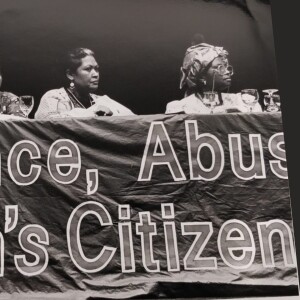
FiLiA Presents the Violence, Abuse and Women’s Citizenship Conference of ‘96
The resilience and courage of the International Women’s Rights Movement in the 90s is retold in this unique exhibition retelling the Violence, Abuse and Women’s Citizenship Conference of ‘96. Legendary feminists including Andrea Dworkin, Phylls Chesler, Norma Hotaling, Jalna Hanmer, Sheila Jeffreys, Janice Raymond and Teboho Maitse attended and, for the first time, women from across the world came together to form alliances.Through this exhibition, we explore the global political and social landscape of the 90s that led to the demand for this phenomenal event.
Listen on:

Episodes
Friday Sep 26, 2025
Friday Sep 26, 2025
From 1996:
"The situation regarding the availability of pornography in the Republic of Ireland is rapidly changing. There is a long history of censorship and considerable legal powers to restrict pornography, but it is also the case that all types of pornography can be obtained and used. There is much public concern, and particularly among women's groups, at the likelihood of massive increases in the availability of pornography as retailers start pushing the limits of what is acceptable.
At a meeting entitled 'An Irish Feminist Response to Pornography' it was agreed that it was essential that women in Ireland consider the issues and develop our own response to pornography which would take account of our unique cultural conditions. The idea emerged of developing an education pack for women's groups to facilitate this. The education pack would provide written material developed specifically for the pack, brief articles and discussion pieces, and references and resource material. The aim would be to locate a discussion of pornography in the context of violence against women, but also in the context of broader discussions about the social construction of sexuality. More specifically, the pack would provide women with resources to develop and articulate their own view of pornography, and to take action based on that.
Geraldine Moane teaches in psychology and women’s studies in University College Dublin. She has been active in the Irish women’s movement since 1976 in the areas of violence, reproductive rights and lesbian issues, and has given many talks and workshops on pornography."
Since 1996:
Geraldine Moane was head of department at University College Dublin from 2002-05, and Director of the Higher Diploma in Psychology from 2005-16. As an academic she specialised in human development, colonialism, oppression, and liberation. She received a life time Achievement Award in 2016. She is also a fiction and creative non-fiction author.
Friday Sep 26, 2025
Friday Sep 26, 2025
From 1996:
"Janice is Professor of Medical Ethics and Women’s Studies at the University of Massachusetts in Amherst. She is the author of many books and articles on the subject of feminism, medical ethics, new reproductive technologies and violence against women. Her key works include A Passion For Friends and the recently published Women as Wombs: Reproductive Technologies and the Battle Over Women’s Bodies. Janice is a member of the Coalition Against Trafficking in Women."
Since 1996:
Janice Raymond is professor emerita of women's studies and medical ethics at the University of Massachusetts Amherst, and author of five books and many articles on topics including prostitution, trafficking, fertility, and female friendship.
Friday Sep 26, 2025
Friday Sep 26, 2025
Please be aware this recording is incomplete.
From 1996:
"This paper explores the feminist debate over whether prostitution is a job option for women or a practice of systematic violence against women. It poses the question of whether prostitution is work that furthers women’s interests or work that is harmful, both to women in prostitution and to women as a group. To answer this question the paper’ compares the dynamics of prostitution to the dynamics of domestic violence and finds that both are premised on male control and female submission; that both reinforce and reify traditional sex roles; that both involve the projection onto women of pornographic fantasies of female sexuality; that both render women easy and frequent targets for violence; that both are inimical to women’s sexual autonomy; that both leave women in need of the same kinds of resources; and that both shape the experiences of women in every sector of society.
The paper then poses the question, if domestic violence and prostitution are both inherently abusive to women, why do so many people condemn the former as violence but justify the latter as work that women choose? The answer is found in the public relations campaign conducted by powerful economic interests invested in the economy of prostitution. The understanding of prostitution as work that empowers women benefits not women but the sex industry and in fact emerges from the industry itself.
Dorchen Leidholdt is Co-Executive Director and co-founder of The Coalition Against Trafficking in Women. She was the principal organizer of the conference, ‘International Trafficking in Women’, held in New York City in 1988, which brought feminist and human rights experts from around the world to address the problem of global sexual exploitation. She has lectured internationally on the sexual abuse and exploitation of women and children and has testified before numerous government bodies. She currently serves as Director of the Center for Battered Women’s Legal Services at Sanctuary for Families in New York City. She is an adjunct professor at City University of New York Law School."
Since 1996:
Dorchen Leidholt is a feminist activist with a focus on rape, prostitution, trafficking, and violence against women. She is a lawyer, Director of the Center for Battered Women's Legal Services, and a law professor at Columbia University School of Law, and has advocated for the implementation of laws to further the rights of women.
Friday Sep 26, 2025
Friday Sep 26, 2025
Christine Stromberger is an Austrian psychologist who helped prepare Austria's Protection Against Domestic Violence Act.
Friday Sep 26, 2025
Friday Sep 26, 2025
From 1996:
"Violence against women in contemporary Russia has its roots in patriarchal social values, anarchy and impunity in the legal system, and women's unemployment and poverty. Sexist attitudes held by most professionals (lawyers, police, physicians, psychiatrists, and social workers) aggravate the situation. Detailed statistics regarding rape and other crimes against women are infrequently published and official statistics differ radically from those collected by independent women's crisis centres.
‘The new independent crisis centres play a large role in reconceptualising the problem of violence against women in terms of patriarchal power and violations of women's human rights. In particular, the Advocacy and Education Project of the Association of Crisis Centres of Russia works to educate the public, to facilitate exchange among crisis centres and to share outreach strategies. Educational programmes and support groups for women help in breaking down stereotypes and assisting women developing assertiveness. This work demonstrates that rape and domestic violence mast be confronted on a political level, for which state funding is needed.
Natalia has worked as a research worker in the Psychology Department, St Petersburg University, since 1983 and is now an Assistant Professor. In 1995 she took part in a Constancy mission on sexual violence in Kyrgystan. Her published articles include Sexism and Sexual Abuse in Russia, Women in a Violent World: Feminist Analyses and Resistance Across Europe, edited by Corrin, C. (1996). In 1994 she was the founder of a non-governmental crisis centre for women."
Natalia Khodyreva is an activist, academic and psychologist, and head of the women’s crisis centre St Petersburg, one of the country’s oldest feminist organisations
Friday Sep 26, 2025
Friday Sep 26, 2025
From 1996:
“Trafficking And Prostitution: Beijing And Its Aftermath – Keynote Address
International policies and legislation increasingly omit prostitution from the category of violence against women. Various governmental and non-governmental groups increasingly make distinctions to legitimise certain practices of sexual exploitation that frame policy and legislation on prostitution and sex trafficking. The Beijing Platform for Action that emerged from the 1995 4th World Women’s Conference is a strong document in its condemnation of violence against women. Unfortunately, it exempts prostitution per se from the category of human rights violations and instead condemns only “forced prostitution”. The Platform, as well as non-governmental organisations (NGOs), distinguish between trafficking in women and prostitution, calling for sanctions only against trafficking. Why are these distinctions and others confusing and misleading, and what impact are they having on international policy and legislation?
Janice is Professor of Medical Ethics and Women’s Studies at the University of Massachusetts in Amherst. She is the author of many books and articles on the subject of feminism, medical ethics, new reproductive technologies and violence against women. Her key works include A Passion For Friends and the recently published Women as Wombs: Reproductive Technologies and the Battle Over Women’s Bodies. Janice is a member of the Coalition Against Trafficking in Women.”
Since 1996:
Janice Raymond is professor emerita of women's studies and medical ethics at the University of Massachusetts Amherst, and author of five books and many articles on topics including prostitution, trafficking, fertility, and female friendship.
Friday Sep 26, 2025
Friday Sep 26, 2025
From 1996:
"
Recounting the experiences of abuse by Asian migrant women workers is like seeing them ‘running the gauntlet’, endlessly testing their endurance and resilience. From pre- departure to actual departure, to arrival at the country of destination, migrant women suffer through untold miseries: economic exploitation at every step, social and psychological violence, as well as physical and sexual violence. Rampant trafficking of women migrant workers is an issue blurred by all these interlocking experiences of abuse. The recent UN Experts Group Meeting on Violence Against Migrant Women Workers held in Manila last May noted that ‘large flows of irregular and undocumented women workers were indications of extensive trafficking networks within and between countries.’ But even migrant women workers who go through all the legal processes of documentation run the risk of being hijacked by traffickers for prostitution or other forms of commercialised sex, forced marriages and forced labour.
Trafficking in women has been so normalised and legitimised within the process of migration that even the women themselves hardly realise they have actually become victims of ‘a serious human rights violation by people they have thought to be helping them. Returned migrant women workers who were lucky enough to escape from these traffickers are still hoping for governments to take action against the trafficking in women.
Raquel is the executive director of the Women’s Crisis Centre in Manila. She studied psychology and women’s studies at the University of the Philippines and at Harvard University. Raquel was an advisor to the World Health Organisation’s Consultation Meeting on violence against women in Geneva, 1996. She also has acted as a consultant to the Committee on Women and Family Relations to the Philippine Senate and to the National Commission on the Role of Filipino Women."
Since 1996:
Raquel Edralin Tiglao co-founded the Manila Women's Crisis Centre and helped the Coalition Against Trafficking in Women begin work in the Asia-Pacific Region. She died in 2001.
Friday Sep 26, 2025
Friday Sep 26, 2025
From 1996:
"Andrea is speaking on the exploitation and abuse of women caused by pornography. She will discuss how pornography lowers women’s civil status.
Andrea is internationally renowned as a radical feminist activist and author who has helped break the silence around violence against women. She is co-author of the pioneering Minneapolis and Indianapolis ordinances in the early 1980's that define pornography as a civil-rights violation against women. She is the author of 12 books of fiction, non-fiction and poetry and has contributed to many anthologies, periodicals, media events and has spoken at activist demonstrations, universities and in cities in many countries. Her critique of pornography and violence against women began with Woman Hating in 1974. This was followed, amongst other books, by Pornography: Men Possessing Women in 1981. This book tells us what pomography actually does and explores the relationship between pornography and women’s civil status. Her most recent work includes a novel, Mercy (1990) and a collection of essays titled Life and Death, to be published."
Since 1996:
Andrea Dworkin was an author of fiction and non-fiction, and a feminist activist with a focus on pornography. She collaborated with Catharine MacKinnon to write anti-pornography Civil Rights Ordinance. She died in 2005.
Friday Sep 26, 2025
Friday Sep 26, 2025
From 1996:
"
I will be describing research undertaken to determine how international human rights standards have, and can, influence legislation on domestic violence at the national level. Research was conducted on four European countries: the United Kingdom, Ireland, the Netherlands, and Slovenia.
The study looks first at current policies and practices (especially the legal system, police practices, and public provision of housing/benefits) regarding domestic violence in each country, evaluating them in relation to international recommendations. Then it looks at the influence of international standards in the policy-making process, comparing it to the influence of other policy actors such as pressure groups and cultural traditions. Finally, the study explores avenues by which international standards could be more effectively employed to influence national government policies this this field.
Helen Gregg has a BA in Modern History and Social Policy from Queen’s University (Belfast) and an MSc in European Social Policy Analysis from Bath University. She has spent time in the Netherlands, Ireland and Slovenia researching policy responses to domestic violence. She is currently working part-time with Christian Aid and is also a teaching assistant in the Department of Sociology and Social Policy at Queen’s University (Belfast)."
Since 1996:
No further information on Helen Gregg was found.
Friday Sep 26, 2025
Friday Sep 26, 2025
From 1996:
"Kathleen is Professor of Sociology at Pennsylvania State University. She co-founded the United Nations Non-Governmental Organisation ‘The Coalition Against Trafficking in Women’. Her publications include The Prostitution of Sexuality: Global Exploitation of Women (1995), which presents a new global analysis, feminist theory and international legal approaches to sexual exploitation. Her most recent publication is Viemam’s Women in Transition (1996). She lectures widely in the US and abroad on women’s rights and international feminism."
Since 1996:
Kathleen Barry is cofounder of the Coalition Against Trafficking in Women, and collaborated on international laws against sexual exploitation. She is an author on topics including trafficking, consent, and a biography of Susan B. Anthony.