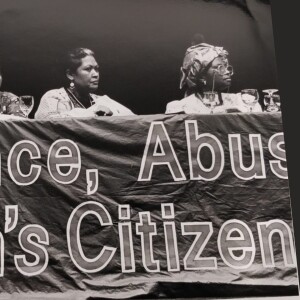
FiLiA Presents the Violence, Abuse and Women’s Citizenship Conference of ‘96
The resilience and courage of the International Women’s Rights Movement in the 90s is retold in this unique exhibition retelling the Violence, Abuse and Women’s Citizenship Conference of ‘96. Legendary feminists including Andrea Dworkin, Phylls Chesler, Norma Hotaling, Jalna Hanmer, Sheila Jeffreys, Janice Raymond and Teboho Maitse attended and, for the first time, women from across the world came together to form alliances.Through this exhibition, we explore the global political and social landscape of the 90s that led to the demand for this phenomenal event.
Listen on:

Episodes
Tuesday Sep 23, 2025
Tuesday Sep 23, 2025
This recording is incomplete.
"As a result of our experiences, we have begun to relate violence and abuse of women, not just as a cultural aberration or a deviation from the law, but as a systemic exercise in the relations of power.
We have moved beyond bandaid measures to protect victims. We have campaigned to prevent the social acceptance of violence. We have, thus, I think, engaged in political processes to change the material reality of our lives and the social basis of human relations."
From 1996:
"After the war of liberation in Bangladesh the new constitution promised equality and rights, but its enforcement was curtailed by traditional considerations of property, economic needs and prescribed gender roles. Military rule in the 1980s led to further reductions in democratic rights and increased poverty. Poor women, especially female headed households, learnt to survive as day labourers or in the export industry, i.e.. textiles. This period also saw an increase in violence against women through dowry deaths, marital desertion and acid burns, and trafficking of women and girl children, Women have continuously confronted systemic violence on their autonomy in the name of family honour or customary practice, on their livelihoods in the name of economic investments, and as victims of trafficking. Women's mobilisation around incidents of rape and kidnap makes our struggle more visible, but no less important is our collective effort to broaden the democratic space, on the basis of equality and justice.
Hameeda is a founder member and current Director of Research and Advocacy at Ain O Salish Kendra, a Legal Aid and Human Rights Centre in Bangladesh. She is actively involved with the National Women's Movement and Global Regional Networks: Asia Pacific Forum on Women, Law and Development (APWLD); and Development Alternatives with Women in a New Era (DAWN). She received a BA from Wellesley College and a D.Phil. in Modern History from Oxford University. Hameeda co-authored No Better Options, a study of women workers in Dhaka, as well as authoring many other publications. Her current research is an oral history of women in political and social struggles."
Hameeda Hossain is a founding member of Ain o Salish Kendra, a legal aid and human rights organisation in Bangladesh, as well as a member of the board of directors of Centre for Secular Space, an international human rights organisation.
Tuesday Sep 23, 2025
Tuesday Sep 23, 2025
"There will be over 2000 women from 100 countries participating in this international conference here this week."
In this clip, from the opening session of the Violence, Abuse, and Women's Citizenship Conference, co-organisers Jalna Hanmer and Catherine Itzin share the origins of the conference.
Tuesday Sep 23, 2025
Tuesday Sep 23, 2025
A capella choir Velvet Fist sang 'No Going Back', by Sandra Kerr, during the opening ceremony of the conference. The song is about how "once we are aware, there is no going back"
Tuesday Sep 23, 2025
Tuesday Sep 23, 2025
"What does it mean that we were silent? Didn't we understand that we were really talking about people being caught, held hostage, tortured, and sent back to places they were fleeing? That should have sounded familiar to those of us who work to end violence against women."" I worry that we'll talk here about how to bring others into consciousness, rather than how to remain truly accountable as a movement to women whose lives are the most vulnerable."
From 1996:
"This presentation will address the ways that discrimination based on gender, race/ethnicity, economic position and age combine to leave young women of colour from low income communities in the US vulnerable to social stigma, violence and abuse, and systematic oppression. The presentation will deconstruct popular media images, public sentiment and contemporary social policy formations to illustrate how young women of colour have become the scapegoats of the problem of conservatism and backlash. In doing so, the speaker will offer a detailed account of how oppression and backlash interact to serve one another and support conservative forces in the US, using young women as a case example.
The presentation will conclude with recommendations for grassroots activism and social policy reform."
Beth Richie is a professor at the University of Illinois, specialising in violence against women, particularly Black women in the United States, as well as incarcerated women.
Tuesday Sep 23, 2025
Tuesday Sep 23, 2025
" Everything is not hunky dory. There's still violence and so on, but I think the awareness is so much and everyone wants to do something about it.
But again, the push is up to us. "
From 1996:
"Shamima’s speech will cover the background of the Fiji Women’s Crisis Centre and the Pacific Network Against Violence Against Women. She will outline programmes, advocacy and lobbying the centre has initiated and organised. The Pacific Regional Training Programme, its courses and attachments on gender violence also will be addressed. She will discuss the impediments to working against violence, including attitudes and hostilities from both unexpected and expected quarters, the influences of cultural and traditional practices, militarism and religious fundamentalism. Shamima will also cover the Post-Beijing Plan of Action in Fiji by discussing the August 1996 meeting in the Pacific. Finally, she will discuss the lack of data in the area of violence against women in Fiji.
Shamima is the Co-ordinator of the Pacific Regional Programme on Women and Violence and a founding member of the Fiji Women’s Rights Movement. She organised the National CEDAW Meeting for Women Leaders (1995), the first and second Pacific Regional Workshops on Women and Violence (1992/1994) and also co-ordinated the first Pacific Women and Law Conference (1994). She has played a leading role in putting violence against women on the Fiji and Pacific political agenda. She has firmly established the Fiji Women’s Crisis Centre, of which she is co-ordinator, as the hub of the Pacific movement against gender violence. Shamima helped set up crisis counselling services in Vanuata and Papau New Guinea. She has travelled throughout Fiji and the Pacific, conducting workshops and seminars on gender violence."
Shamima Ali is Coordinator of the Fiji Women's Crisis Centre, and was named Pacific Person of the Year 2011 in recognition of her campaigning and activism.
Tuesday Sep 23, 2025
Tuesday Sep 23, 2025
CAUTION: VOLUME WARNING
The conference speeches were recorded on cassettes, which have been digitised. Some of the cassettes were found to have very poor audio quality, and have been carefully and painstakingly restored by the FiLiA team. This sample shows a before vs after of this process.
Friday Sep 26, 2025
Friday Sep 26, 2025
From 1996:
Valerie Sinason is a Consultant Research Psychotherapist specialising in work with learning disabled abuse victims and offenders and with survivors of ritual abuse. She works at the Tavistock and Portman Clinics, the Anna Freud Centre and St. George’s Hospital Medical School. She is currently completing a Dept. of Health funded research project into allegations of ritual abuse. Books include Treating Survivors of Satanist Abuse (ed.) and Memory in Dispute (ed.)
Since 1996:
Valerie founded the Clinic for Dissociative Studies in 1998, and remained Clinic Director until 2016. She is president of the Institute of Psychotherapy and Disability and a director of the International Society for the Study of Trauma and Dissociation. She has written more than 100 papers and 20 books.
Friday Sep 26, 2025
Friday Sep 26, 2025
From 1996:
"Kate Cook is a feminist activist who has worked within the Rape Crisis movement for a number of years supporting women who have been raped and/or sexually abused. She is now a law student and a campaigner for legal change within Manchester Justice for Women. She is also a member of Franki: Greater Manchester Women’s Support Project, which takes support services to women who otherwise would not have access to them (women in prison and secure units and women working in the sex industry)."
Since 1996:
Dr Kate Cook teaches criminal law at Manchester Metropolitan University and is co-head of the Sylvia Pankhurst Gender Research Centre. She is co-author of 'Rape Crisis: Responding to Sexual Violence' and is a researcher focused on violence against women and children.
Friday Sep 26, 2025
Friday Sep 26, 2025
From 1996:
"
Bangladesh’ is a densely populated country in which poverty and malnutrition are serious problems particularly affecting women and children. Trafficking in women and children for forced prostitution, organ trade, and slave labour is becoming increasingly evident. Poverty, illiteracy, ignorance of the law, and women’s oppressed status in society all contribute to their vulnerability to trafficking. There are thousands of Bangladeshi women languishing in jails in India, Pakistan, Malaysia, and Thailand due to illegal immigration papers and false passports. UN Conventions clearly prohibit trafficking in women and children. These have been signed by Bangladesh, Pakistan, and India yet the trade flourishes. Urgent actions must be taken nationally and internationally to prevent trafficking and protect the lives of women and children.
Bangladesh National Women Lawyers Association is working to stop this inhuman flesh trade. We have formed a coalition with NGOs in India, Pakistan, and Nepal to prevent trafficking. Locally, we have implemented an innovative grassroots approach providing legal aid, an awareness campaign, and human rights education. Posters, leaflets, lectures and discussions, and video and audio cassettes are all employed to convey information and raise concerns. Shirin Naher is an Advocate at the Supreme Court of Bangladesh and an active member of the Bangladesh National Women Lawyer’s Association. Shirin is also involved with Maitree Parishad, an NGO working with deprived, exploited street children on health awareness and child rights issues. She has worked as the Secretary of Women’s Affairs in Dinajpur Samity, is a member of the North Bengal Development Association and the Executive Committee of People’s Human Rights Commission. Shirin participated in the UN World Conference on Women in Beijing in 1996."
Since 1996:
As of 2004, Shirin Naher was the Deputy Program Manager of Protection and Legal Action Against Women and Child Trafficking on behalf of the Bangladesh National Women Lawyers' Association.
Friday Sep 26, 2025
Friday Sep 26, 2025
Marie-Victoire Louis is a sociologist specialising in sexual violence committed against prostituted women. She founded AVFT, the Association Against Violence Against Women at Work, in 1985.