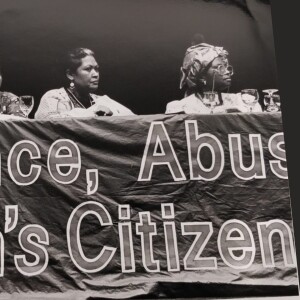
FiLiA Presents the Violence, Abuse and Women’s Citizenship Conference of ‘96
The resilience and courage of the International Women’s Rights Movement in the 90s is retold in this unique exhibition retelling the Violence, Abuse and Women’s Citizenship Conference of ‘96. Legendary feminists including Andrea Dworkin, Phylls Chesler, Norma Hotaling, Jalna Hanmer, Sheila Jeffreys, Janice Raymond and Teboho Maitse attended and, for the first time, women from across the world came together to form alliances.Through this exhibition, we explore the global political and social landscape of the 90s that led to the demand for this phenomenal event.
Listen on:

Episodes
Monday Oct 06, 2025
Monday Oct 06, 2025
In this speech, Nighat Said Khan analyses the forms of violence women experienced during the Partition of India and Pakistan, and ongoing patterns of violence against women in conflict.
Nighat Said Khan is a founding member of the Women's Action Forum, a Pakistani women's rights organisation, and the Applied Socio-Economic Research Centre. She is Dean of the Institute of Women's Studies Lahore.
Monday Oct 06, 2025
Monday Oct 06, 2025
From 1996:
The cause of abuse of children and women remains controversial in the Philippines, given the lack of research and experience. To enable the Province of Aklan to move forward with its resolve to free the land of abuse, a research project covering all the municipalities of the area was conducted. This was done to enable the Council to understand the specificities of its culture. Most important, the study provided for a feel of the awareness of the people of the laws which have been set for their protection. The results were used to identify the strategies which for change. Even before the recent Tri-Media Campaign launched by the country as a result of the World Congress on Child Sexual Exploitation, Aklan was moving way ahead in answering the issues. This paper will share the results of the research, from design to utility.
Irene V. Fonacier-Fellizar earned her Fellowship in Gender and Gtobal Issues at the University of California Davis in 1995. A Registered Social Worker, she is Executive Director of the Children’s Laboratory for Drama in Education; Consultant to CSWAG Development Foundation in Aklan Province, Philippine AIDS NGO Support Program and others; Board Member of the Center for the Prevention and Treamment of Child Sexual Abuse; and member of, among others, the AIDS Society of the Philippines and the Philippine Health Social Science Association.
Since 1996:
Irene Fonacier-Felizar is the President of the AIDS Society of the Philippines, and has contributed to Unesco resources on HIV education.
Monday Oct 06, 2025
Monday Oct 06, 2025
In these speeches, Atuki Turner, Ravi Thiara, and Dhanwant Rai, discuss research by Women's Aid Federation England into the experience of Black women in English refuges, both as service users and staff, and how this could be improved.
Atuki Turner is now a Ugandan activist and co-founder of MIFUMI, which works to end violence against women in Uganda.
Ravi Thiara is now Professor of Sociology at the University of Warwick.
No current information on Dhanwant Rai was found.
Monday Oct 06, 2025
Monday Oct 06, 2025
Please be aware this recording has an abrupt start. The speaker has not been identified but may be Brandi Britton or Jenna Kalfsbeek.
From 1996:
Women are the fastest growing group of people infected with HIV. Women of colour and poor women are at disproportionate risk of becoming infected. Two modes of transmission of the HIV virus predominate: needle sharing when injecting illicit drugs, and heterosexual contact with a high-risk partner. Violence against women is a widespread problem among drug-addicted subcultures. Up to 70% of these women report being battered by their partners, more than half have been victims of childhood sexual abuse, and more than half report having been victims of rape or attempted rape as adults. Prostitution is a common means through which addicted women must support themselves and their children. Women also experience rape and battery from sex customers and from pimps while working as prostitutes. Within the context of ongoing victimization, women find it difficult to employ safe sexual and needle using practices.
This paper presents findings from three research projects on women and HIV in the United States which point to several important connections between violence against women and women’s HIV/AIDS risk. Points of intervention and directions for social change are outlined based on these findings.
Since 1996:
Brandi Britton was a professor of sociology and anthropology at the University of Maryland. She died in 2007. Her death was ruled a suicide, though this has been questioned by commentators.
No current information on Jenna Kalfsbeek has been found.
Monday Oct 06, 2025
Monday Oct 06, 2025
In this brief statement, an unidentified woman draws attention to the experiences of so-called 'comfort women' in the Second World War, on behalf of the conference.
Monday Oct 06, 2025
Monday Oct 06, 2025
In this brief statement, an Indigenous Australian woman makes a statement on the lack of Indigenous Australian speakers at the conference.
Monday Oct 06, 2025
Monday Oct 06, 2025
In this brief statement, Vayana Rubaira discusses the impact of nuclear testing on the environment and human beings, and calls for change.
No current information on Vayana Rubaira was found.
Monday Oct 06, 2025
Monday Oct 06, 2025
In this brief statement, Cita Morei calls, on behalf of the conference, for a nuclear free Pacific and the liberation of the Pacific Islands.
Since 1996:
Cita Morei continues her activism for women's liberation and nuclear disarmament, and has written two books on these topics.
Monday Oct 06, 2025
Monday Oct 06, 2025
At the end of the conference, co-organiser Jalna Hanmer gives thanks to everyone involved.